Showing posts with label broadcasting. Show all posts

Sunday, December 10, 2017

Does tennis fanbase have an age problem?

SportsBusiness Daily has reported earlier this year about the demographics of major sports' fanbases in the United States. Tennis has one of the oldest fanbases of all sports with an average age of 61 for the ATP's TV viewers and an average age of 55 for the WTA. The only major sport with older TV viewers than the ATP is the PGA Tour with an average of 64 years. The ATP's average has increased by five percent since 2006. The WTA is at least showing a positive trend by being the only major sport where the average age has decreased, by eight percent since 2006.

Of course, those are only American numbers but I'm still a bit surprised by how old the fanbase of tennis is in the USA. Tennis has traditionally been a game of young players, dominated by players in their 20s, although 2017 saw players like Roger Federer, Rafael Nadal, and the Williams sisters having great success still in their 30s.

In the American market, global sports tend to have a younger audience than North American sports, soccer and Formula One being examples of that. That makes it somewhat surprising how old the tennis fanbase in the USA is. On the other hand, the USA has greater traditions in tennis than in many other global sports, explaining the older fanbase.

There is a trend in many sports that younger fans tune in only for something big. Those young adults with work and kids don't want to spend all their spare time watching sports. As an example from tennis, the Wednesday night session featuring the Keys-Kanepi and Federer-Del Potro quarterfinals was the most-viewed US Open telecast both overall and in the 18-49 age group, though the women's semifinals and the final had more viewers in the non-18-49 demographics. Young adults wanted to see the much-anticipated Federer-Del Potro match; for comparison, the Nadal-Anderson final had only half of the 18-49 audience of the Federer-Del Potro quarterfinal.

Lack of American stars may explain why the WTA's fanbase in the USA is younger. Ever since Andy Roddick won the 2003 US Open, no American man has won a Grand Slam tournament whereas American women have achieved a total of 21 Grand Slam titles since 2004. The WTA provides more must-see matches for American people than the ATP does. The Stephens-Keys US Open final had 25 percent more viewers than the Nadal-Anderson men's final, in the 18-49 age group it had 58 percent more viewers.

Young adults are likely able to spend less time watching TV than retired old people. That may be the reason for the increased cord cutting, especially among young adults. Why pay for cable channels you don't have time to watch? Streaming services will be a big part of the future of sports broadcasting. People want to be able to watch from their mobile devices wherever they are and they don't want to pay for content they aren't watching.

All the numbers above are from the USA but it's easy to assume there are some global trends there. Streaming services are replacing traditional subscription channels around the world. Young, working adults with small children don't have as much time to watch sports as retired people have. Yet still, young adults are fascinated by major sports events and want to watch them.

Tennis needs young stars


With the average age of the fans increasing, the sanctioning bodies of tennis are trying to make the sport more appealing to younger generations. The ATP experimented some rule changes at the Next Gen Finals, including no-ad scoring, a best-of-five format with sets played to four games, and on-court coaching.

I'm not sure tennis needs those rule changes. A match played as best of five sets to four games will be 12 to 35 games, with the current rules of best of three sets to six games it's 12 to 39 games. No big difference there. No-ad scoring would shorten the matches, though it would come at the expense of thrilling extended games. Hardly an improvement.

What I think tennis needs to attract younger generations is young stars. After all the years they have spent on the top of the game, Federer, Nadal, Djokovic, and Murray don't appear as young and exciting.

Tennis needs young stars whom young adults and teenagers can identify with. But how can the sanctioning bodies get them when the old guard is still too strong?

It's almost crazy how fit some players in their 30s are. Federer, Wawrinka, and Nadal would be retired at their age if they were 1990s players, yet they can beat younger players with their stamina. Today's tennis is very physical and players in their late teens or early 20s aren't ready to win major titles. Stan Wawrinka won his first slam at the age of 28; that's the age when players had usually reached their peak and started to decline. Grigor Dimitrov won his first Masters 1000 title at the age of 26 after years of big expectations.

Tennis needs to become less physical to help young players to break through (among many other reasons). Speeding up the courts would help in that. A young player who has the skills but not the stamina would be more capable of beating seasoned veterans if the game was less grueling.

Tuesday, September 19, 2017

Solid summer ratings for IndyCar on NBCSN

The 2017 Verizon IndyCar Series saw its viewership growing throughout the season. The viewership was down early in the season and the ratings were down for ABC's free-to-air telecasts, yet solid ratings throughout the summer boosted the viewership on NBC's cable channels over the previous years' averages.

The table below shows the viewership in thousands for NBC's cable telecasts.

Click to enlarge

Total Audience Delivery for NBC's telecasts in 2017: 507,000.
  • Up three percent on 2016 (492,000; excludes the rain-delayed Texas and Pocono races)
  • Down one percent on 2015 (510,000)
Overall average viewership for ABC, NBCSN, and CNBC in 2017: 1.14 million (17 races)
  • Down 11 percent on 2016 (1.28 million; 15 races)
  • Down 1.7 percent on 2015 (1.16 million; 16 races)

Early 2017 did not look positive for the Verizon IndyCar Series' TV ratings. The ratings for the free-to-air telecasts on ABC were down, as well as the ratings for Long Beach and Phoenix on NBCSN was down. The Honda Indy Grand Prix of Alabama at Barber Motorsports Park was an exception, showing growth of over 60 percent in audience, though it was aided by a NASCAR race having a rain delay.

The Rainguard Water Sealers 600 at Texas Motor Speedway was the first race back on NBCSN after ABC's coverage from Indianapolis and Detroit. The Texas race started a strong streak for IndyCar's TV ratings for the rest of the season; eight of the last nine races had over 500 thousand viewers.

The Honda Indy 200 at Mid-Ohio was the most-viewed IndyCar race on cable in 2017; the live telecast on CNBC had 200 thousand viewers and the tape delayed NBCSN telecast had 576 thousand viewers following a NASCAR race. The most-viewed live telecast was the ABC Supply 500 at Pocono with 618 thousand viewers.

None of the 2017 races could match the most viewed races of the previous two seasons; in 2016 Mid-Ohio had 1.0 million viewers, thanks to the rain delay at a NASCAR race. In 2015 Sonoma had 841 thousand viewers, though the 2015 race took place three years earlier when the football season had not started and there was no NASCAR Cup race that weekend.

Although IndyCar could not achieve its previous top ratings on cable in 2017, the solid ratings since June improved the average audience compared to previous years. The Bommarito Automotive Group 500 at Gateway Motorsports Park was the only race since June with less than 500 thousand viewers as it took place in the same night as the Mayweather-McGregor fight.

Attracting younger generations IndyCar's challenge


While the average audience for the Verizon IndyCar Series on NBC's cable channels grew by eight percent from 2016, the average for those aged between 18 and 49 went down by four percent. Over the full season on ABC and NBC's channels, the 18-49 age group's viewership was down 10 percent. The 18-49 age group made up 22 percent of the IndyCar audience both on NBC's cable channels and on ABC.

The percentage of viewers aged 18-49 is slightly lower for IndyCar than it is for the NASCAR Cup Series or NHRA, for both of which it is around 25 percent. However, IndyCar's open-wheel rival Formula One has over 30 percent of its American viewers aged between 18 and 49. While IndyCar has a slightly higher average audience, F1 has more viewers in the 18-49 age group.

An obvious explanation for the growth of the viewership in the older generations may be that there are fans of Indy car racing that were lost in the split. INDYCAR's aim was to make those lost fans interested in the series again, and the audience growth implies it has succeeded in it. However, there is a younger generation of fans who grew up during the split and were never into Indy car racing. Gaining new fans from the younger generations is the next challenge for INDYCAR.

Gaining young fans is crucial for the long-term future of the series. A series with a good future outlook is also more attractive for sponsors, which in turn will help the series to grow. IndyCar already gets overshadowed by NASCAR in American media; if it can't attract young fans, it will be overshadowed by F1 as well. Then again, if IndyCar could attract young fans like F1 does, it could outnumber NASCAR's Trucks and possibly the Xfinity Series in the 18-49 audience.

Numbers via Awful Announcing, Showbuzz Daily, Sports Media Watch, NBC Sports Pressbox, and Adam Stern on Twitter.

Tuesday, June 6, 2017

Are IndyCar's ratings on ABC a reason to be worried?

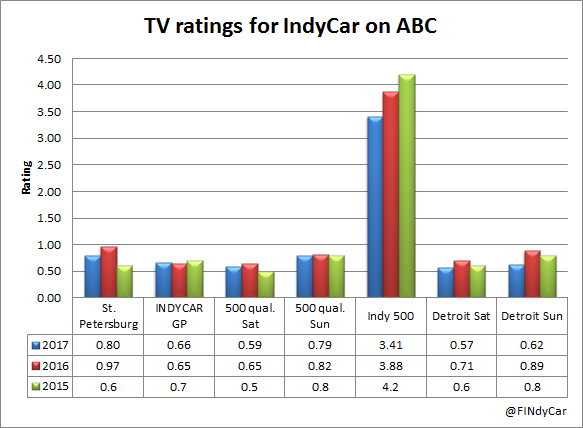
The doubleheader Chevrolet Detroit Grand Prix concluded ABC's coverage of the Verizon IndyCar Series for this season as the remaining nine races will be broadcast by NBC Sports Network. Five races and two qualifying days for the Indianapolis 500 had in total 11.5 million viewers on ABC. That is 11 percent down from 12.9 million last year, and seven percent down from 12.3 million viewers in 2015.

Click to enlarge

Excluding the Indy 500 and its qualifying, the four regular races had 980 thousand viewers on average on ABC. That is down 16 percent from 1.2 million last year and the same as in 2015. Only the INDYCAR Grand Prix at the Indianapolis road course was up in viewership compared to last year whereas only the Firestone Grand Prix of St. Petersburg had more viewers than in 2015.

There were many positives for INDYCAR from the Month of May. However, the 101st Indianapolis 500 was the lowest-rated 500 with a final rating of 3.4 with 5.5 million viewers, down 12 percent in ratings and nine percent in viewers from last year (3.9 rating, 6.0m viewers). The drop wasn't such a big surprise as last year was the celebrated 100th Running and the local blackout was lifted. However, the 2015 Indy 500 had earned a final rating of 4.2 with 6.5 million viewers, despite the local blackout.

The drop in the Indy 500's American ratings was compensated by increased viewership in Europe, thanks to F1 star Fernando Alonso's participation. The viewership in Alonso's native country Spain averaged at 361,000 viewers with a share of 2.9 percent. That was above F1's Monaco Grand Prix the same day which averaged 212 thousand viewers and 302 thousand a year earlier. In the United Kingdom, the 500 averaged at 129 thousand viewers and a share of 0.91 percent, up 975 percent from 12 thousand a year earlier. The Indy 500 was broadcast on a pay channel in both Spain and the UK.

Declining viewership isn't only IndyCar's problem, in fact NASCAR and NHRA are experiencing even more dramatic drops in viewing figures. Also Formula One suffers from declining viewership worldwide, though in the USA its ratings have improved so far this year.

IndyCar behind F1 in the 18-49 age group


The Monaco Grand Prix in the Memorial Day weekend earned a 1.0 final rating with 1.4 million viewers. It was the most-viewed F1 race on NBC's channels since the group became the American F1 broadcaster in 2013. Excluding the Indy 500, no free-to-air IndyCar telecast on ABC could match those numbers.

While the difference in the viewership isn't particularly big between F1 and IndyCar, F1 has considerably more viewers aged between 18 and 49 years. 31 percent of the viewers of the Monaco GP were from the 18-49 age group. For the five earlier F1 races this season on NBCSN, the average is 33 percent. Excluding the 500, the four races shown on ABC had only 24 percent of viewers from that 18-49 age group, and on NBCSN the average so far is 23 percent.

The Indy 500 didn't see an increase in the share of viewers aged between 18 and 49 years. The last two years, 22 percent of the 500's viewers have been from that age group, below the average of the other races shown on ABC. That is opposite to NASCAR's flagship race, the Daytona 500, which had 30 percent of its viewers in the 18-49 age group whereas the average for the other races on Fox this year was 26 percent.

Also, while the gap in the viewership of the Indy 500 (5.5 million) and NASCAR's Coca-Cola 600 (4.6 million) was the biggest since 2000 in favor of the 500, they both had the same viewership of 1.2 million in the 18-49 age group. Though a year ago, the Coke 600 had more 18-49 viewers despite the 500 having more viewers in total.

Given that IndyCar and F1 have lots of similarities but also certain differences, a good question is why F1 gets more viewers in the USA, especially in the 18-49 age group.

Formula One is known as the pinnacle of motorsports for a reason. It has the fastest cars for road courses, the F1 cars are technically the most advanced race machines alongside Le Mans Prototypes, and most of the top talent in open-wheel racing are in F1. If anything, F1 is relatively unknown in the USA compared to the rest of the world.

On the other hand, the Verizon IndyCar Series has the fastest race cars in the USA, apart from F1's annual visit to the States. While IndyCar lacks the technical competition of F1, its closer field provides better racing, and ovals add to the versatility of the series. Nine of the 21 full-season cars are driven by Americans whereas there are no American drivers in F1 despite an American team. The F1 races are mostly early in Sunday morning whereas IndyCar races are in the afternoon or evening. And IndyCar offers more chances for American fans to go and see races live.

If I had to make an assumption on why F1 gets more viewers than IndyCar in the USA excluding the 500, I'd say that's because of F1's status as the pinnacle of motorsports. No matter how great racing IndyCar provides, there will always be people who insist on F1's supremacy because it draws most of the open-wheel talent and has the higher levels of engineering.

The 18-49 age group was probably the most impacted by the split of American open-wheel racing. The younger generations of that group were still teens or even kids during the split years. With the American open-wheel racing split in two, F1 may have been the most attractive open-wheel series to start following back then.

Also, the technological skills of the younger generations may be behind F1's popularity in the 18-49 age group. If you follow the international motorsports press, F1 dominates there. Thanks to Internet, you can follow series that don't get much coverage in your local sports news. Probably no other series has so much coverage between the races as F1, making it easy to stay engaged with it.

If there's any major flaw in the Verizon IndyCar Series, I'd say it's the length of the season, or rather the offseason. Hardly any major series in motorsports goes away for half of a year. I get the INDYCAR management's point of avoiding the football season but the long offseason kills the momentum the series had gained during the season. INDYCAR leaves the fans craving for other racing, like NASCAR or F1 that already dominate the media. Even if TV ratings for fall races were hit by football, the longer season would keep fans more engaged with the series.

Alonso's running at Indy generated lots of interest among F1 fans. Given that, I was disappointed the Indy 500 viewership declined also in the 18-49 age group. Maybe Alonso's participation had very little effect on the American viewership of the 500 or maybe it saved it from even bigger of a decline.

I'm not so worried about IndyCar's declines ratings on ABC this year. While the ratings were down on ABC, the three first races on NBCSN have averaged 378 viewers on average, up nine percent from last year and up 15 percent from 2015. Yet the age structure of IndyCar's fanbase is worrying. IndyCar has a smaller part of its viewers in the 18-49 age group than F1 or NASCAR have. It's important IndyCar can attract younger fans to ensure the series' long-term health.

The future of IndyCar broadcasting


As ESPN, which produces ABC's IndyCar coverage, has laid off their motorsports staff, it seems like INDYCAR will need to find another broadcaster for the races they want to have broadcast free-to-air. ESPN still is under contract of showing five races on ABC in 2018, though the layoffs imply they may give up those rights a year before the contract expires. And anyway, INDYCAR needs to negotiate a new over-the-air broadcast contract for 2019 onwards.

NBC would seem like a logical choice for the over-to-air coverage as they already broadcast 12 races on cable. Broadcasting the full season, NBC might put more effort in promotion than ABC which shows only five races. A single broadcaster might also be more flexible in their choices to show races free-to-air; currently ABC's coverage is centered around the Month of May and the entire second half of the season is on cable on NBCSN.

INDYCAR also needs to have a look into the streaming services. MotoGP already offers a streaming service, and F1 might as well if the contracts with local broadcasters didn't prevent it. If INDYCAR or its broadcast partner offered a streaming service without having to pay for other content, that could be a way to make cord cutters watching the Verizon IndyCar Series. But streaming can't completely replace the TV coverage of the series; streams reach only the hardcore fans, TV enables reaching the big crowd.

Numbers via Awful Announcing, Showbuzz Daily, Sports Media Watch, The F1 Broadcasting Blog, and FormulaTV.