Saturday, July 19, 2014

Rule changes in F1 in the past ten years and my opinion on them

Niki Lauda has suggested that the rule changes of the last ten years should be reconsidered. (Original article in German) The article lists the 77 rule changes of the last ten years. 45 of them were in the Technical Regulations and 32 in Sporting Regulations. Here are the changes and what I think about them.

Changes to the Technical Regulations for 2005

  • The engines must last 2 Grand Prix weekends (instead of one)
  • The front wing must be at the height of 15cm (instead of 10cm)
  • The rear wing must be moved 15cm closer to the car
  • The diffuser may be at maximum 12.5cm high
The longlife engines have been something I have never really liked. In my opinion, racing cars should be build so that they can just finish the race but could hardly last any longer. Finishing the race should be a technical challenge. As the engines are nowadays build to last multiple races, technical retirements have become quite rare in recent years. I would really like to see the return for new engines for each GP weekend but that is obviously very unlikely to happen. That would increase costs too much.

As for the aerodynamic changes for 2005, I don't have much to say. Obviously they were intented to help overtaking as the cars' aerodynamic sensitivity has made following another car so difficult.

Changes to the Sporting Regulations for 2005

  • The qualification consists of two single laps the times of which will be aggregated
  • Tyre changes during the race are banned
  • Teams from the fifth place in the Constructors' Championship may run a third car on Friday
The single-lap qualifying didn't work too well in F1. The previous format with 12 laps in 60 minutes didn't have much action early in the session but the single lap qualifying lacked the intensity of the last minutes in the previous format.

Banning tyre changes was a bad decision in my opinion. Having one set of tyres for the race forced drivers to look more after their tyres, and I don't think that kind of tyre management belongs to F1.

Allowing a third car for lower-placed teams wasn't a good rule in my opinion. After a weak 2004 season, McLaren had a third car for Friday practices whereas their title rival Renault didn't have one. That sounds like un unfair rule.

Changes to the Technical Regulations for 2006

  • Engines with 8 cylinders and 2.4 liter capacity
That was obviously not a very popular rule change back then after 3-litre V10s. But now people are missing even those V8s and their sound.

Changes to the Sporting Regulations for 2006

  • Qualification with a three-phase knockout system
  • Tyre changes are again allowed
The single-lap qualifying wasn't very popular as it lacked the intensity of the former qualifying format. The three-phase qualifying brought that intensity back but the knockout system means there is action on track already early in the qualifying.

Reintroducing the tyre changes was a good thing in my opinion. As I wrote above, I think one set of tyres for a race required too much tyre management.

Changes to the Technical Regulations for 2007


  • Maximum RPM of engines 19,000, development frozen
I was sceptical after 2006 about how the engine homologation will work out. I was afraid that one manufacturer will have a better engine than others and the others can't catch up in the following seasons. Well, the same engines in 2013 were pretty equal in performance, even though Renault had been given a permission to develop their engine before 2009 because they were behind others because of a different rule interpretation. But now there are new engines and their development for next seasons is restricted. My fear from 2006 may happen now; it is unsure if other manufacturers can catch Mercedes as they can't design a completely new engine.

Changes to the Sporting Regulations for 2007

  • The Friday practice consists of two 90min sessions (instead of two 60min sessions)
  • During a Safety Car period, the pit lane remains closed until all cars are in queue behind the Safety Car
  • Single supply tyres: During the race, both tyre compounds must be used
  • Maximum of 14 tyre sets per driver per race
  • Maximum of 30,000 testing kilometers per team
Costs have been tried to cut by limiting testing outside race weekends and the practice sessions were made longer to offer more testing during the race weekends.

I have had mixed feelings about single-supply tyres. On one hand, I think the tyre war belongs to F1. On the other hand, tyres may have played a bit too big role. In 2006, there were some obvious Bridgestone races and some obvious Michelin races. That was a bit too predictable. When it comes to the mandatory use of both compounds, I am not completely sure it improves racing. Most drivers will have the same optimal tyre strategy, even though it enables some gambles with strategy. But it means there are some drivers with different tyre compounds so that should create some overtaking. I wouldn't say the mandatory use of both compounds is such a bad rule. The limited number of tyre sets per weekend obviously helps to cut costs.

The Safety Car rules for 2007 were changed to prevent the race to pits during yellow flags before the Safety Car. The downside of those rules was that you can't exploit the lead you had before the Safety Car to have a pitstop plus if you had to pit for refuelling before pitting was allowed again, you got a penalty. Luckily that rule isn't anymore in effect.

Changes to the Technical Regulations for 2008

  • Introduction of standard electronics, no more traction control
  • Gearbox must last 4 GP weekends
A reason for introducing the previously banned traction control in 2001 was that it was impossible to police. Standard electorics enabled banning it again. I think the ban of traction control is a good thing. You can hear how people say that today's F1 cars are too easy to drive, the lack of traction control makes them at least a bit more difficult.

My opinion on longlife gearboxes is similar to my opinion on longlife engines. In my opinion, no components should be required to last more than one weekend. But the longlife gearboxes are to restrict costs so they are there to stay.

Changes to the Sporting Regulations for 2008

  • Spare cars are banned
Not a big deal in my opinion. That may have reduced the number of mechanics needed so would cut costs a bit.

Changes to the Technical Regulations for 2009

  • The big aero reform with 180cm wide front wings (instead of 140cm)
  • 75cm wide rear wings (instead of 100cm)
  • 95cm high rear wings (instead of 80cm)
  • Diffuser height 17.5cm in center, 12.5cm outside
  • Winglets and fins on the bodywork banned
  • Return of slick tyres
  • Maximum RPM of engines 18,000
  • Maximum of 8 engines per year
  • KERS allowed, 82 hp for 6.7 seconds per lap
The new aerodynamics rules were aimed to help overtaking by enabling to follow a car ahead closer than previously. Unfortunately it is still difficult to follow a car ahead in fast corners where you could gain more time than in slow corners, so overtaking is still difficult. One downside of the 2009 regulations was that in tight racing, the wide front wings got easier damaged than previously. The return to slicks was aimed to compensate the loss of downforce by having more mechanical grip.

As it has became obvious, I don't really like the idea of longlife components but I have preferred the rules for engine life since 2009. Now you don't automatically get a penalty from an engine change unless you have used too many engines during the season or the car is in Parc Ferme after the qualifying.

The introduction of KERS was obviously something F1 had to do. They had to bring some eco aspect to F1, even though the road relevance of F1 KERS is debatable.

Changes to the Sporting Regulations for 2009

  • Pit lane during Safety Car periods again open, delta time for the inlap
  • Maximum of 15,000 testing kilometers and 20 test days
  • Maximum of 60 wind tunnel hours per week, 60% models at maximum, maximum of 40 teraflops computer capacity
The pit lane could again be kept open during a Safety Car period as with the delta time for pit stops, drivers were prevented from racing to the pits under yellow flags.

In order to cut costs, testing as well as the use of wind tunnels and computational fluid dynamics has been restricted. Personally I must say, I don't miss in-season testing so much. The downside of restricted on-track testing is that it favours teams with better wind tunnel and CFD facilities whereas smaller teams would be more in line with the big teams in on-track testing. On the other hand, unlimited track testing would mean that the richest teams could spend huge amounts of money in developing the car what smaller teams couldn't do.

Changes to the Technical Regulations for 2010

  • Tyre width restricted to 245mm (front) and 325mm (rear)
  • Minimum weight 620kg (instead of 605kg)
  • KERS voluntarily abandoned
The front tyres were too wide in relation to the rear tyres in 2009, so they were made narrower. But as a reason to return to slicks was to provide more mechanical grip, why did the FIA make the front tyres narrower and not make the rear tyres wider? Wider rear tyres would have brought more mechanical grip and made the cars less aero-dependent.

In 2009, KERS didn't bring much advantage; the two best cars of 2009 didn't even have KERS. The weight of KERS affected to the weight distribution of the car and to reduce that disadvantage, the minimum weight was increased, even though the teams had agreed not to use KERS in 2010.

Changes to the Sporting Regulations for 2010

  • New points system 25-18-12-10-8-6-4-2-1 (instead of 10-8-6-5-4-3-2-1)
  • Refuelling banned
  • 11 tyre sets per driver per GP weekend (instead of 14)
  • Maximum cost of customer engines €9 million
  • 15 testing days (before the season) + 3 (after the season) with 1 car per team
  • At a restart after a Safety Car period, overtaking allowed after the SC line at pit entry (instead after the start/finish line)
  • Maximum of 47 staff members per team at track
The aim of the new points system was to increase the value of race wins. The previous system had the opposite aim, to reduce the points difference between winning and finishing second, in order to reduce team orders. But the problem was that the incentive to risk a second place for a win was too small. Now there is more incentive for that. Also, given the great reliability of the cars, getting points had gotten harder, so it is justifiable to give points to two more cars.

Refuelling was banned for safety reasons. I must say, I miss refuelling. It brough more tactical aspects to racing, even though that may have meant less action on track as the drivers were relying on the pit strategy.

Once again, costs were tried to cut with some rules: reduced number of tyre sets, cap on engine price, restrictions on testing, and restrictions on staff.

Changes to the Technical Regulations for 2011

  • Double diffuser banned. Maximal diffuser height over the whole width 12.5cm
  • F-duct banned
  • Introduction of the Drag Reduction System. Free use in practice and qualifying, in race in certain places
  • KERS again allowed
  • Minimum weight 640kg (instead of 620kg)
  • Fixed weight distribution +/- 1%
  • Gearbox must last 5 GP weekends
Unintented loopholes in aerodynamic regulations were removed, like double diffuser and F-duct. KERS was introduced again, and with the higher minimum weight, carrying KERS wasn't anymore such a disadvantage but an advantage because of its extra horsepowers. Gearboxes must last one more race longer, obviously to cut costs.

Drag Reduction System was an easy solution to increase overtaking. When you are close enough, you get a speed advantage helping you to get past the car ahead. But that kind of passing isn't very spectacular. I would have regulations that would make the cars such that you can overtake with them more easily, without aids like DRS. And if there must be an overtaking aid, I would prefer IndyCar-style push-to-pass. You can use it only for a certain number of times during a race, so you must manage push-to-passes, and you can use it also to defend.

Changes to the Sporting Regulations for 2011

  • Team orders allowed
Ferrari's team order at Hockenheim in 2010 showed that the ban on team orders doesn't work so there is no need for that ban, even if team orders aren't good PR for the sport.

Changes to the Technical Regulations for 2012

  • Chassis height at the front axle 55cm (instead of 62.5cm)
  • Regulations for the position of the exhaust tailpipe
  • Retarted ignition with all 8 cylinders banned
The FIA wanted to prevent teams from using exhaust gases to improve downforce. Quite understandable when the series aims towards fuel efficiency.

Changes to the Sporting Regulations for 2012

  • Race duration with breaks 4 hours at maximum
  • When overtaking, both drivers must leave a car's widh space
  • Unlapping during Safety Car periods
I don't like the unlapping rule during Safety Car periods. People were complaining when there were lapped cars between cars fighting for the same position preventing the driver behind attacking at the restart. But why should he be able to attack at the restart; he was so much behind before the Safety Car that there were some lapped cars between. This seems like a rule intented to improve the show. Of course, there was a safety aspect, some slow lapped cars might have been dangerous at restarts. But this unlapping also takes some time, why do those lapped cars have to unlap themselves, why couldn't they just be told to let the cars behind lap them? That would take much less time.

With standing restarts in 2015, it seems like Safety Car periods are being used to bring some action. I much prefer how they do at Le Mans where they try to avoid safety car periods with yellow flag zones where you must slow down noticeably. Le Mans wants the Safety Car to affect to the race as little as possible, F1 as much as possible.

Changes to the Technical Regulations for 2013

  • Double DRS banned
  • DRS use also in practice and qualifying only in the DRS zone
  • Minimum weight 642kg (instead of 640kg)
An obvious reason to allow the use of DRS only in the DRS zone also in the practice and qualifying sessions was to avoid using it in dangerous places. On the other hand, less opportunities to use DRS may lead to teams going for shorter gears. Then the advantage from DRS in the race is smaller.

Changes to the Sporting Regulations for 2013

  • Maximum of 12 testing days (instead of 15)
  • Maximum of 60 staff members at track
These regulations were obviously aimed to control costs.

Changes to the Technical Regulations for 2014

  • The big engine reform with 1.6-litre turbo V6, direct injection, and  two electric units MGU-K and MGU-H
  • Maximal fuel flow of 100kg per hour
  • 8-speed gearbox (previous maximum 7-speed)
  • Maximum of 5 engines per driver per year
  • Exhaust position central in rear, only one exhaust
  • Maximal nose height 18.5cm
  • Front wing width 165cm (instead of 180cm)
  • Rear wing with two elements at maximum (previously three)
  • Minimum weight 691kg (previously 642kg), brake-by-wire allowed
  • Gearbox must last 6 GP weekends
  • Introduction of a standard side crash structure
The new engins have been criticized a lot, mostly because they are too silent. I can imagine it takes something away from the live viewing experience. But I think the new engines were a step to right direction. Hybrid technology is getting more and more important for car manufacturers, and for them to participate in F1, F1 must have some road relevance. But I think the fuel flow maximum could be abolished, I don't think saving fuel belongs to F1.

Changes to the Sporting Regulations for 2014

  • Maximum of 100kg of fuel for a race
  • Double points in the season finale
  • Introduction of penalty points: with 12 points during 365 days a race ban
  • Personal numbers for drivers for their entire career
  • Ban of FRIC?
The double points in the last race are another rule to improve the show. I don't think that belongs to F1. F1 has always been about who is the best driver throughout the season, not who is the best driver at the end of the season. I'm afraid F1 may be going towards a NASCAR-style Chase for the Championship where the last races decide the champion and early races don't have much importance for the outcome.

The personal numbers aren't such a big deal but I would have preferred assigning the permanent numbers to teams. In car racing, the numbers usually belong to the car owners, and the number system used in F1 until 1995 basically had semi-permanent numbers for teams, so there would have been legendary numbers like 27 and 28 for Ferrari or 5 and 6 for Williams.

How would I change regulations?


As for the Technical Regulations, I would go for more road relevance, that would bring more car manufacturers to F1. Maybe more freedom in the regulations. At Le Mans, Audi, Toyota, and Porsche have completely different engines. If you think about F1, Ferrari and Renault are completely different car manufacturers. What is relevant for one of them is not necessarily for another of them. Allow more freedom and F1 would be more attractive for car manufacturers. As for the Sporting Regulations, I would prefer less gimmicks to improve the show and I would like the rules to promote more pure racing.

And moreover, I would prefer more stability with the rules. At the same time, F1 wants to cut costs but is constantly changing rules, which brings costs to teams. More stable rules would make F1 more attractive for new teams and engine manufacturers.

Monday, July 7, 2014

What next for Novak Djokovic and Roger Federer?

Today's Wimbledon final was a big match for both players, Novak Djokovic and Roger Federer. Djokovic's last Grand Slam title was from the last year's Australian Open. After that, he has always been beaten in slams by the eventual champions, and he didn't seem to play his best tennis in those matches. Most recently, he lost the French Open final to Rafael Nadal after winning the first set. The question was if he could finally play his best game in a Grand Slam final and win it.

Federer won his last Grand Slam title at Wimbledon two years ago, which made him again the World No. 1. But 2013 was a bad year for him, for the first time since 2003, he fell out of the top 4, he won only one title, and his Wimbledon title defense ended on the second round ending his streak of 36 consecutive Grand Slam quarterfinals. His 2014 season with a new racquet and a new coach Stefan Edberg had started much better; he was fourth in the Race to London ranking and now he was playing in his first Grand Slam final in two years, at the mature age of 32. Could he win it and surpass Pete Sampras in Wimbledon titles as well as get one further Grand Slam title away from Rafael Nadal.

Well, Djokovic won the final in five sets. He was the better player most of the match. Federer took the first set to tiebreak and won it but Djokovic won the next two. Djokovic was up a break in the fourth set and serving for the championship but then Federer broke back, his first break in the match. In the following game, Djokovic had a match point in Federer's serve but Federer could hold his serve and broke Djokovic's serve in the following game to take the match to the fifth set. At this point, it seemed like Federer was the better player on court. But Djokovic could hold his serves, and nerves, and at 5-4, he broke Federer's serve to win the championship.

But what to expect from these players in the future? It is somewhat surprising that Djokovic won his second Wimbledon title before his second US Open title as grass is considered as his worst surface and hardcourt as his best. The higher number of excellent hard-courters compared to excellent grass-courters explains that, as well as today's Wimbledon playing more like a fast hard court where you don't necessarily need special grass skills. Still, despite the US Open not being his most successful tournament, he is now my favourite for that title. He is the best hardcourt player on the tour. Hopefully now after ending the Grand Slam drought at Wimbledon, he has more mental strength in big points, what he has lacked so often at slams in the last two years. And as he is very unlikely to reach Federer in Grand Slam title count, or even another great of this era, Nadal, his biggest aim must be to complete the career Grand Slam at the French Open. I wrote about his chances to win the French Open in the last month, and now all I can add to it is that at least next year he won't have the pressure of winning no Grand Slam titles in the previous 17 months.

Then, what to expect from Federer? I am afraid this was his last big chance to win a slam. He is playing an excellent year, he will be the World No. 3 on Monday, ahead of Grand Slam champion Stan Wawrinka. But I am afraid it is not anymore in his racquet. Djokovic is now better than Federer on grass. Nadal is better, at least on clay and hard courts. I think also Wawrinka is very dangerous, he beat Federer on Monte Carlo's clay and I believe he can play on a higher level also on hard courts. And there are dangerous players like Nishikori and Gulbis. As well as Roger is playing, he played better in 2012 when he won his last slam. In 2012, he routined Djokovic in the Wimbledon semifinal, today he lost to him. Although I don't rate Djokovic even close to peak Federer as a grass-courter, I must say he is now better on grass than Federer, today's match showed that. And if Murray can find his old form, I think he could also be better than Federer on grass. All in all, I am afraid the days are over when Federer could outplay the opposition to win a slam. Even on his beloved grass, there are now players that can play better than him. Now he needs some luck to win a slam, he needs others underperforming. Outside grass, that is very difficult, there are too many players that can beat him. On grass, a slam might be possible, there aren't so many excellent grass-courters. But there is only one slam on grass, and every year Federer is one year older and has declined more. I see it very hard for Federer to win another slam. Maybe the chance to surpass Sampras in Wimbledon titles motivates him to fight against decline to win one more Wimbledon title. But I am afraid Wimbledon 2012 will remain as his last Grand Slam title. Today he had a chance to win yet another but he couldn't do it. It won't be any easier in the future, just harder.

Tuesday, June 24, 2014

The future of Williams?

A front row lockout and finishing third and fourth at last weekend's Austrian Grand Prix was a great result from Williams whose last years have had lots of ups and downs. They fell from a top team to a midfield team once their partnership with BMW ended after the 2005 season. 2011 was their worst season in decades, ninth position in the constructors' championship with only five points. After that, one could wonder if there were any hope for a better future for Williams. That's why their good form in the 2012 season was a positive surprise. Pastor Maldonado won the Spanish Grand Prix for the team, their first win since Juan Pablo Montoya at the 2004 Brazilian GP. Yet they couldn't finish higher than eighth in the constructors' championship; Maldonado was way too inconsistent and Bruno Senna didn’t have the pace.

2013 was again a difficult season for the team. Just like in 2011, they finished ninth in the constructors championship with five points. After the season, Maldonado, with his PDVSA sponsorship, left the team for Lotus. Valtteri Bottas, who had replaced Bruno Senna after 2012, stayed in the team, and a former Ferrari driver Felipe Massa became his new teammate. The team also had to end their engine partnership with Renault and they switched to Mercedes engines.

The switch to Mercedes engines was probably the best thing that could happen to Williams. Mercedes has built the best 2014-spec engine, as shown by their own team dominating the series. That's why also Mercedes' customers have had good results this year. But you can't explain Williams' good form with only the Mercedes engines. They are ahead of McLaren, an established top team. Force India are two points ahead of Williams but they gained lots of points compared to Williams in the early season. Williams seem like the only team besides Red Bull that might have pace to challenge Mercedes, even though Williams doesn't perform everywhere as well as at Montreal and the Red Bull Ring.

But can they repeat this season's results next year and re-establish themselves as a top team? That is hard to say but I am a bit sceptical. I believe that at least some of Red Bull, Ferrari, and McLaren will be stronger next year and will be able to challenge Mercedes. This season is for Williams a bit like the 2012 season was for Williams and Sauber. Suddenly a midfield team has a car capable for podium results, yet they couldn't repeat the success in the following year. One advantage for Williams is the Mercedes engines, though. If Mercedes could retain their advantage for the next year, Williams might find themselves fighting against usual top teams like Red Bull, Ferrari, and McLaren.

The Mercedes engines may have helped Williams to become again a team that can race for podium results but if they are to become a true championship contender, they may need to have another engine partner. After all, Williams are Mercedes' customers and I am not sure they would get full support, especially if that might cost Mercedes' own team a title. McLaren could have stayed as a customer team for Mercedes who are probably the best engine manufacturer in F1. Instead they start a works engine partnership with Honda. Being a customer team isn't an ideal position if you want to race for the titles.

Williams need results like they have had this year to convince some car manufacturer to enter into a works partnership with them. What I think is good for Williams, is that they seem to be financially more stable than other midfield teams, making them more attractive for a long-term partnership. Besides, their non-F1 engineering services might make them an attractive partner for a car manufacturer. Still, at the moment there isn't much talk about potential new engine manufacturers, so having Mercedes customer engines is the best they can have at the moment. Those are the best engines available and help them to establish themselves as a strong midfield team. That is where they need to be to have a chance to become a works team for a new engine manufacturer.

To establish themselves as a strong midfield team, they need also a strong driver line-up. Bottas and Massa is a good pairing, especially Bottas has had some very impressive race performances. But Bottas has been so good that I expect him to leave Williams for a better team in few years unless Williams becomes a true top team. Having at least one excellent driver is necessary for a team. Williams' 2012 season is an example on that. The car had lots of potential, as shown by Maldonado's win in the Spanish GP. But Maldonado was very inconsistent and Bruno Senna lacked pace. With a stronger driver line-up, they might have finished a couple of positions higher in the final standings.

Finding good drivers is difficult for a midfield team, especially as they aren't able to pay much but would rather have drivers who would bring some sponsors. But Williams aren't here alone. The likes of Lotus, Force India, and Sauber have this same problem. One can hope that the good results of this year would bring some new sponsors for Williams to be able to have a strong driver line-up as well as engineering department. Unfortunately we have seen in recent years that good performances don't guarantee new sponsors for midfield teams. Lotus was strong in last two seasons and Sauber in 2012, yet those teams have had financial difficulties.

Williams are having a great season but they still have a long way to become a real top team. They need results like this to attract new sponsors and maybe some car manufacturer to enter into a works partnership. More sponsor income and works engines are in my opinion what Williams need to become a championship contender again.

Monday, June 16, 2014

My report of the 2014 24 Hours of Le Mans

This year's 24 Hours of Le Mans is now behind. For me this was the second Le Mans I really followed. I followed as much of last year's race as possible and enjoyed it, and this time I wanted to see the entire race, and it was a truly great race.

This year marked the return of the works Porsche team to Le Mans. I was happy to see Porsche going to Le Mans; they are such an iconic brand in racing and one of my favourite car brands. I really hope they will have success at Le Mans, yet this year I was actually hoping them not to win. I didn't want them to humiliate Audi and Toyota in the first year after their comeback, especially as Audi is another of my favourite brands.

Audi has dominated Le Mans since 2000 winning all but two races, 2003 and 2009. That's why it is understandable many people wanted to have a new winner. Still, my sympathies were on Audi's side, partly because of their difficult week. The #1 Audi R18 driven by Loic Duval crashed badly in Wednesday's practice session. Duval didn't injure himself badly in the accident but was he had to miss the race and was replaced by Marc Gene. The #1 Audi also couldn't participate the first qualifying session on Wednesday. The qualifying wasn't too good for other Audis, too. The three R18s occupied the starting positions 5 to 7, behind the Toyotas and the Porsches.

Early in the race, #14 Porsche had some fuel system problems that forced it to pits being repaired. Then, with just under two hours of racing, it started to rain heavily and we had some drama. The #8 Toyota driven by Nicolas Lapierre seemed to spin by itself to barriers on the wet track, and at the same a GT Ferrari, driven by Sam Bird hit the #3 Audi driven by Marco Bonanomi. The Audi had to retire whereas the Toyota was able to continue the race but lost lots of time being repaired.

At night, the #1 Audi had to pit to get the fuel injector changed. Also the #14 Porsche faced again problems, being forced to have again a long pit stop. Meanwhile the #7 Toyota was racing with a comfortable lead of almost two minutes to the second-placed #2 Audi. Then, in early morning we had the most dramatic moment of the race. The leading #7 Toyota had been reported to have stopped at Arnage and the #2 Audi took the lead. An electrical problem had forced the Toyota to retire from the lead.

Now, despite all the struggles of the week, the Audi team found themselves having a one-two lead in the race with #2 in the lead and #1 second. The #20 Porsche was on the third place in front of the #8 Toyota and #14 Porsche who had lost lots of time in pits during the race. But the race was far from over, there was still more than the duration of a regular WEC race to finish. And it wasn't a comfortable finish for Audi. The #2 R18 dropped to third position because its turbocharger had to be changed. Now the #1 Audi was leading the race, after being heavily crashed on Wednesday's practice. One of its drivers was the record-winner of Le Mans, Tom Kristensen, aiming for his tenth win.

But nothing was predictable in this race. The #1 Audi also had to get its turbocharger changed, which dropped it to the 3rd place. Now the #20 Porsche was leading the comeback race of the manufacturer in Le Mans. But the #2 Audi was coming fast from behind and it got past during the pit stops. Eventually, the #20 Porsche couldn't even make the podium as technical issues forced it to retire. Also the #14 Porsche had to pit because of technical problems but it was sent back to track at the end of the race to cross the finish line.

In the end, the race was won by the #2 Audi R18 driven by Marcel Fässler, Andre Lotterer, and Benoit Treluyer. The #1 Audi R18 driven by Tom Kristensen, Marc Gene, and Lucas Di Grassi finished second and the #8 Toyota TS040 driven by Anthony Davidson, Sebastien Buemi, and Nicolas Lapierre finished third.

Many people must have found yet another Audi win boring but I was happy for them after all the difficulties they had this week. In some ways, I can understand the joy of Rafael Nadal's fans after his maybe the worst French Open-winning performance. In both cases, the old winner was vulnerable but nobody else had what it takes to win.

At the same time, I feel gutted for Toyota. They did everything right in the race but to win a 24-hour race, you must have the reliability and they didn't have. They were the fastest car this year and I hope they can win Le Mans soon, even though Toyota doesn't raise the same passion in me as Porsche or Audi.

Porsche had an excellent comeback race even though technical issues ended it. Before those issues, they had even one car racing for the win. I hope and believe they can have success in the next years and have tight battles for wins against other teams. While I was happy that Audi could win after the difficult week, I hope to get a new winning manufacturer as soon as possible. Despite Audi's win, at least this year the battle for the win involved three teams, so you can't say Audi winning was inevitable.

Besides the LMP1 class, I enjoyed the GTE classes. Especially the battle for the win of GTE Pro was exciting with wheel-to-wheel racing. The #51 Ferrari of AF Corse, #97 Aston Martin, and #74 Chevrolet Corvette were battling for the win of GTE Pro. Unfortunately first the #74 Corvette and then the #97 Aston Martin faced technical problems, ending the battle for the win before the race ended. I wanted Aston Martin to have a good result as their last Le Mans was a sad race because of Allan Simonsen's death in the GTE Am class. That's why I was really gutted about the power steering issue that took them off from battling for the GTE Pro class win. Every cloud has a silver lining, though. My countryman Toni Vilander was driving the winning AF Corse #51 Ferrari with Gianmaria Bruni and Giancarlo Fisichella. And Aston Martin could win the GTE Am class with the #95 V8 Vantage GTE; the same number that Simonsen had at last year's Le Mans. Unfortunately their #98 V8 Vantage GTE faced some technical issues while leading the GTE Am class; otherwise they could have had one-two in the class.

I really enjoyed the race, 24 hours of great racing and drama, and no artificial gimmicks like DRS or tyres designed to degrade like in F1. Le Mans and other WEC races aren't so hard to follow for an F1 fan, as there are many F1 drivers there. My motorsport interest is definitely moving from F1 to Le Mans and the WEC.

Monday, June 9, 2014

Will Djokovic ever win the French Open? Or even another slam?

This year seemed to be the golden opportunity for Novak Djokovic to win the elusive French Open title. The biggest obstacle to win the title, Rafael Nadal, had not been too impressive after the Australian Open and he played his worst pre-French Open clay season despite being able to win the Madrid Masters and make the final at the Rome Masters. Djokovic had a wrist injury during the Monte Carlo Masters but the wrist was healthy for the Rome Masters which he won, defeating Nadal in the final. So everything seemed fine for him before the French Open.

After the early losses of potential black horses Stan Wawrinka and Kei Nishikori, the French Open was a two-horse race between Djokovic and Nadal, like in the previous couple of years, and it ended with a Djokovic-Nadal final. Despite winning the first set, Djokovic's performance was lame. He couldn't hit through Nadal's defense often enough and Nadal could exploit it if Djokovic left the court open. And mentally his performance was poor. He lost his serve in the last games of the last three sets, being on serve in second and fourth sets. And the match ended with a double fault, just like the French Open final two years ago.

I am starting to believe that Djokovic just doesn't have what it takes to beat Nadal at Roland Garros. He can beat Nadal in Masters events on clay but Nadal will always bring his best to the French Open. Plus there is the pressure of the missing slam from the Career Grand Slam, which doesn't help him.

I think Djokovic's chances to win the French Open depend on how fast he will decline, how fast Nadal will decline, and how fast the new generation will come. Given Nadal's injury history, one can assume Djokovic will have a couple of years more on the top of the game. Plus there may be a year when Nadal has an injury, giving others a great chance to win the title. But Nadal's bad year may come too late for Djokovic. Djokovic is 27 and he can't keep his current level for many more years; next year he will already be older than Roger Federer when he won his only French Open title. Also, there will be new players coming to the top of the game. The tour has been dominated by players in their late 20s plus few in their early 30s. But recently there has been some good performances by younger players. Kei Nishikori was already close to beat the French Open champion Nadal in the Madrid Masters final before a back injury forced him to retire. If he can still develop, he will be a big challenger for the ageing Djokovic. Ernests Gulbis' semifinal run at Roland Garros was also impressive, and if he can start to live up to his potential and develop, he is another challenger. And there are young players like Grigor Dimitrov and Dominic Thiem with lots of potential. In a couple of years, Nadal may already have declined and isn't anymore Djokovic's tougest opponent even on clay but there may be other players who keep him from winning the French Open.

So what I think about Djokovic's chances to win the French Open? I think he still has years to win it. David Ferrer is 32 and still he is playing excellent clay tennis. Nadal will have issues with his body and can't keep on winning year after year. Also, I don't see another as dominant a clay-courter as Nadal emerging, so I believe Novak will still have a few more chances. But even if he didn't have to play against Nadal, he will have to play with the pressure of winning the missing Grand Slam title. One can wonder if that has been the reason why he hasn't been able to beat Nadal at Roland Garros unlike at all clay Masters.

Today's loss was Djokovic's third consecutive lost Grand Slam final. Add to that, his losses at last year's French Open and this year's Australian Open were tight five-set losses to the eventual champions. One can wonder why the player who was so dominant in 2011 cannot anymore win slams; his last slam is the Australian Open last year. I think things started to go wrong for him at last year's French Open. He lost the semifinal against the eventual champion Nadal despite leading the final set with a break. After that we saw a lame performance in the Wimbledon final. In last year's US Open final, he wasted lots of chances in the third set, eventually losing it, and played a bad fourth set after that, losing the match. And today's final didn't look like he has the mental fortitude to win.

Maybe he is starting to feel pressure to win a slam. He hasn't been able to repeat the three-slam season of 2011. If things are getting hard, he seems unable to get over those difficulties the way he did in the exhaustingly-long 2012 Australian Open final which he won despite being down a break in the final set. I definitely believe he will win more slams, he is just so good. But if he is facing trouble in the match, he may not find the way to get over it.

Tuesday, May 27, 2014

My view into the first half of Stan Wawrinka's 2014 season

Stan Wawrinka lost today on the first round of the French Open against Guillermo Garcia-Lopez. That was a big disappointment since he is the World No. 3 and the winner of the season’s only Grand Slam event, Australian Open, as well as the Masters event on Monte Carlo’s clay courts.

Wawrinka’s season has been quite a rollercoaster. He started the season with a title in Chennai and after that he sensationally won the Australian Open defeating Novak Djokovic and Rafael Nadal on his way. That title showed he can beat anybody in the World. He was the first player since Sergi Bruguera at the 1993 French Open to defeat the two top seeds in a Grand Slam tournament. Also, he was the first non-Big Four player since Juan Martin del Potro at the 2009 US Open to win a Grand Slam tournament. He is a bit similar player to Jo-Wilfried Tsonga and Tomas Berdych, he has an offensive game with heavy groundstrokes. But why have those two never won a slam and Stan has? I think a reason is that Stan is more consistent from the baseline; he won’t commit as many errors in long rallies against the great defences of the likes of Nadal and Djokovic.

After the Australian Open, there were high expectations on Wawrinka, even though some people were also wondering if he is only a one-tournament wonder. He played in the Davis Cup first round in Serbia in the weekend after the Australian Open where he had trouble in beating Serbia’s Dusan Lajovic. After that weekend, he didn’t play before the Masters event in Indian Wells. He started the tournament promisingly but his run ended against Kevin Anderson on the round of 16. He didn’t make it any further in the following Masters event in Miami where he lost to Alexandr Dolgopolov. After Miami, Stan played in the Davis Cup quarterfinals in Switzerland. He wasn’t too impressive in that tie, he lost his first singles rubber to Kazakhstan’s Andrey Golubev and with Roger Federer, they lost the doubles rubber against Andrey Golubev and Aleksandr Nedovesov. He won one rubber that weekend, the must-win fourth rubber against Mikhail Kukushin.

After those weak performances, more people were asking if he can really challenge the top players on a constant basis. Two weeks after that difficult Davis Cup weekend, Stan showed he isn’t a one-tournament wonder as he won the Masters event on clay in Monte Carlo. He dropped only one set in that tournament, in the final against Federer. Especially his semifinal performance against David Ferrer, who had just beaten Nadal, was very impressive. It seemed like he could be one of the biggest favourites for the French Open, Djokovic had a wrist injury, Nadal was off-form, and he had just beaten Federer and Ferrer.

As Stan was playing so well, he dropped the 250-point event of Oeiras from his schedule and his next event was the Masters event of Madrid. There he lost his first match against the young talent Dominic Thiem, after winning the first set 6-1. In the following week in a Masters in Rome, he made it to the round of 16 where he lost to Tommy Haas. After the title in Monte Carlo, his results from Madrid and Rome weren’t what was expected. He had some back issues but this started to remind of the time of Indian Wells and Miami. After a big title, he couldn’t live up to expectations. But after some worse performances, he could bounce back in Monte Carlo. Could he do it again, this time at Roland Garros?

Well, he couldn’t. He started his first round match against Guillermo Garcia-Lopez well and in the fourth game, he broke into a 3*-1 lead. But after that, things started to go wrong for Stan. Right in the next game, Garcia-Lopez broke back and in Stan’s next service game, he broke into a 4*-3 lead. Stan had started making lots of errors. That is how the match went forward. Garcia-Lopez won the first set. In the second set, Stan had again a lead of a break but lost it later. In the end, Stan could break to win the set 7-5 but right in the first game of the third set, Garcia-Lopez broke. Stan couldn’t reduce errors and he was getting desperate. After a hold to 2-3* in the third set, Stan couldn’t win any more games, Garcia-Lopez won the third set 6-2 and the fourth set 6-0.

So, what went wrong with Stan at the French Open? Why are his three titles his only tournaments this year where he has made it past the round of 16? If we exclude the big titles from the Australian Open and Monte Carlo, he was having a better season a year ago. He was more consistent back then.

I think he isn’t used to his new status as a Grand Slam champion. There is nothing wrong with his game; he was awesome in Monte Carlo. But it all comes to down to if he can play his best game. Maybe he is floating after all his success this year and taking matches too easily. Then if things don’t go his way, he will get desperate. I think that is what happened today. After being unable to hold his serve after getting a break, he started making errors and was unable to get his game together for the rest of the match. Then, as he couldn’t get the match back on track, in the last one and a half sets, despair took over.

I think he had too high expectations for the French Open. He had won a slam this year and he had shown in Monte Carlo that he can win a big clay tournament. He forgot to concentrate on the game; he expected wins to come more easily. I think the same happened already after the Australian Open. He had high expectations for the American Masters events and he failed to live up to those expectations. I think those bad results helped him to get the right mentality for Monte Carlo. He knew there are no easy wins. I hope today’s loss makes the same. I believe today’s loss brings him down to earth, concentrating fully on the game, expecting no easy wins. And if he enters another slam with as high expectations, I believe he will be able to handle those expectations better.

But what to expect from Wawrinka in the future? Can he win more big titles, can he win even another slam?

I believe he will bounce back. He has shown in last one and a half years so many times that he has the skills to challenge and beat anybody on the tour. I expect good results from him in the second half of the season. The grass season may be difficult for him; he has never been excellent on grass. Given his great performances at the Australian Open and Monte Carlo, I believe he will still win big titles. He can even win another slam. I fancy his chances in the hardcourt slams. Clay may be his preferred surface but I think a medium paced surface like hardcourt suits him best against the likes of Djokovic and Nadal. Hard courts aren’t too fast for Stan but they enable him to hit through the best defences. But he is already 29. He won’t have many chances to win big titles. If he is to win another slam, I think he must do it within the next two years.

Monday, May 5, 2014

My visit to ATP Munich

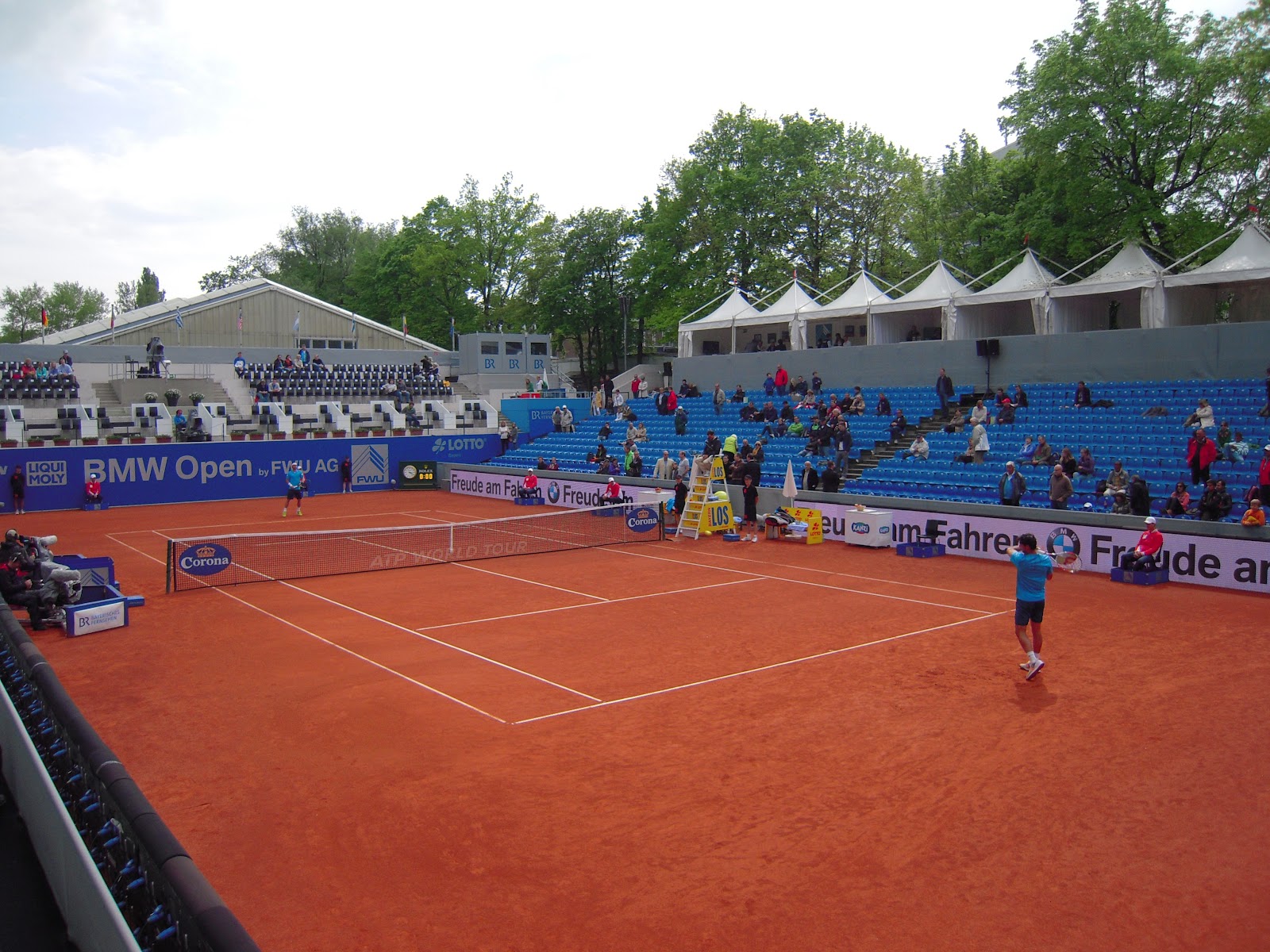
Last week I was able to fulfil one of my dreams and see ATP-level tennis live. I visited the BMW Open in Munich on the quarterfinals day. Now I want to share some of my photos from that day.

The club house of the tennis club MTTC Iphitos.

The club house of the tennis club MTTC Iphitos.

A Rolls-Royce on display at the club.

Jakob Schnaitter in a junior match.

The winner's prize car in front of the scoreboard.

The doubles team of John Peers and Jamie Murray.

The doubles team of Eric Butorac and Raven Klaasen.

The catering area.

The Info Tower.

The centre court in Munich.

Next I will go to the singles matches played on the centre court.

Martin Kližan def. Denis Istomin 7-6(3), 1-6, 6-1


I missed the first two sets of the match but saw most of the third which was total destruction by Kližan. Kližan had a bad 2013 season but he has had some good results on clay this year and eventually he won the Munich tournament.

Kližan serving against Istomin.

Tommy Haas def. Andreas Seppi 6-3, 3-6, 6-3


Tommy Haas is one of my favourite players so it was great to see him playing. Unfortunately he has had shoulder issues this year and he isn't playing on his best level. Still, he could produce some nice shots and it was great to see him winning in front of a German crowd.

Haas hitting a backhand against Seppi.

Haas hitting a volley.

Seppi serving.

Fabio Fognini def. Thomaz Bellucci 6-2, 6-2


You can hear people saying Fabio Fognini is the dark horse of the French Open. I must say I didn't see it in this match why he could have big success at Roland Garros. Bellucci was playing more offensively and hit some flashy winners. But he made way too many errors, which even made the crowd frustrated.

Fognini (left) and Bellucci (right) warming up.

Fognini hitting a forehand.

Bellucci hitting a volley.

Players shaking hands after the match.

Jan-Lennard Struff def. Ričardas Berankis 4-6, 6-3, 6-4


I was one of the few people in the crowd whose favourite was Berankis as Struff played in front of his home crowd. Struff is a tall player with a big serve. Berankis, on the other hand, is small for a tennis player and can't rely on outpowering his opponents but he has more variety in his game than Struff. Berankis was doing the right things and took the first set from Struff. In the second and third sets he was unable to break Struff's serve, though, and Struff was able to break Berankis once in both sets to win the match.

Struff serving against Berankis.

Berankis hitting a volley.

Struff giving signatures after winning the match.

All in all, it was a great day. I think you can get more of the game when you are watching it on site compared to watching it from TV. You can see e.g. spin better as well as things like bounce height or net clearance. This was my first tournament visit and definitely not the last. I can recommend all tennis fans going to a tournament.